
DIGITAL MARKETING
Food and Restaurant Brands: From Kitchen to Content
Food brands live and die by perception. It’s not just about how the food tastes—it’s about what people say, what they remember, and what shows up when someone searches your name. Across these projects, I found myself working less like a marketer and more like someone quietly shaping how these brands are experienced—both online and in real life.
Giardino Gelato: Rewriting the Narrative
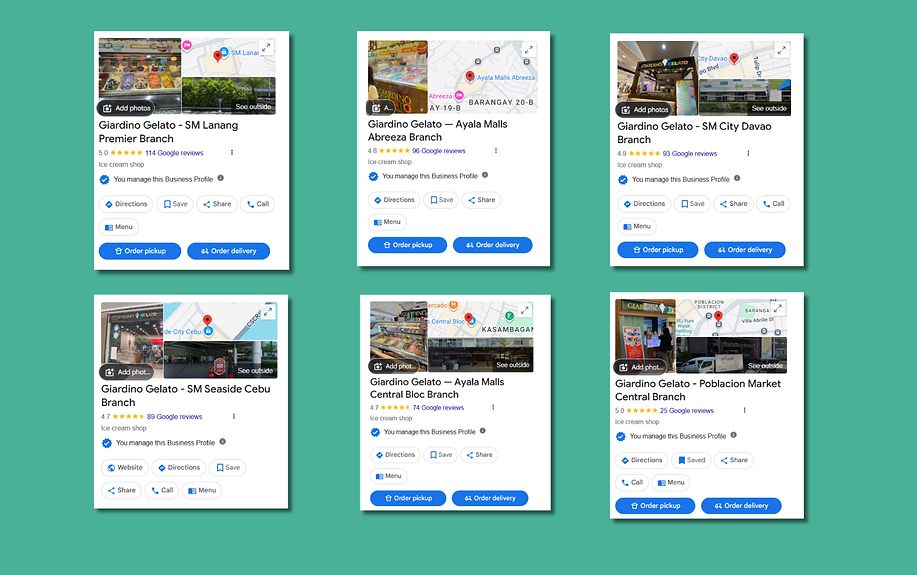
When I stepped into Giardino Gelato, the problem wasn’t the product—it was the story being told about it. Negative reviews were dominating their Google presence, creating a version of the brand that didn’t reflect what customers actually experienced in-store. And because those reviews couldn’t be removed, the only way forward was to change what people saw first. Instead of running a loud campaign, I kept it quiet—almost invisible online. For 60 days, across all branches in Cebu and Davao, we encouraged real customers at the store level to leave reviews through a simple QR system. No noise, no announcements—just consistent, real feedback from people who actually tried the product.
Slowly, the narrative shifted. New reviews came in. Photos were uploaded. Locations became more visible. What used to be buried under negative perception was replaced by something more honest—something that reflected the brand better.
What started as a fix became something more: a stronger Google presence, better search visibility, and a growing library of real customer voices the brand could finally stand behind.
Giardino Gelato: Documenting the Product
There was also a gap behind the scenes. Despite having a wide range of flavors, there was no complete visual reference for the team—nothing that fully captured the identity of each product. So I built one from scratch. Over multiple visits and two months of shooting, I documented every flavor and turned it into a structured photobook. Not just a collection of images, but a working tool—something staff could use to better understand what they were serving, and how to present it to customers. It became a quiet but important piece of the brand—something that doesn’t show up in campaigns, but improves every customer interaction.
.png)
The Green Bounty Kitchen:
Turning Customers into the Brand
With The Green Bounty Kitchen, the focus wasn’t fixing perception—it was building it. I spent over a year managing their content and online presence, but what made the biggest difference wasn’t just posting regularly—it was shifting who the brand was centered around.
Instead of speaking for the brand, we let customers speak as the brand. We highlighted their reviews, their photos, their experiences. Meals weren’t just posted—they were shared through the people who enjoyed them. Over time, this created something more than engagement—it built a sense of community. People started tagging the brand naturally. Reviews became part of the identity. And slowly, the numbers reflected that shift—moving their Google rating from 3.5 to 4.3, not through forced campaigns, but through consistent, real experiences being shared.


Touchdown Cafe:
Building with What’s Available
Touchdown Cafe was different. There was no full system, no big budget—just a business trying to establish itself.
So the approach was simple: make things clearer, one step at a time.I created basic visual direction, short-form videos, and social posts that gave the brand a more defined look. I also helped with packaging design for their in-house products—small details, but important ones.
It wasn’t about building everything at once. It was about giving the brand enough structure to stand on its own, even with limited resources.